“There they rest, inert,
impertinent, in gallery space—those book forms either imitated or mutilated,
replicas of reading matter or its vestiges. Strange, after its long and robust
career, for the book to take early retirement in a museum, not as rare manuscript
but as functionless sculpture. Readymade or constructed, such book shapes are
canceled as text when deposited as gallery objects, shut off from their normal
reading when not, in some yet more drastic way, dismembered or reassembled.”
Monday, March 23, 2015

Women in the Book Arts

The Book As Art: Artists' Books from the National Museum of Women in the Arts
Women have been pioneers in the field of book arts, crafting intimate and insightful works that blend word, image, and media together in exciting and unique ways. Whether produced as one-offs or manufactured in serial form, these volumes share a wonderful craft aspect that has broad appeal to fellow artists, collectors, and ordinary readers alike. Often highly conceptual in form, they stretch the boundaries of what constitutes a 'book.' This illustrated volume presents over 100 artists books held in the permanent collection of the Museum of Women in the Arts, Washington, D.C. The publication of this trade book corresponds with the institution s twentieth anniversary celebration. With an engaging introduction by acclaimed fiction-writer Audrey Niffenegger and essays by curator Krystyna Wasserman and renown book arts scholar Johanna Drucker, the text compliments the highly engaging profiles of each work, which will be illustrated in multiple views. Artist biographies, and a comprehensive bibliography round out the offerings.
The 16th Century connection

Artists' Books: The Book As a Work of Art, 1963-1995 – November, 1995
by Stephen Bury (Author)
The spread of printing in the 16th century severed the relationship between artist and book, but modern developments in technology have enabled this relationship to be restored. This work explores the history of artists' involvement with the book format of the 20th century.
The book form's contemporary objecthood.

Bookwork
MEDIUM TO OBJECT TO CONCEPT TO ART
added !0 272 pages | 12 color plates, 68 halftones, 1 line drawing | 8-1/2 x 11 | © 2011
“There they rest, inert, impertinent, in gallery space—those book forms either imitated or mutilated, replicas of reading matter or its vestiges. Strange, after its long and robust career, for the book to take early retirement in a museum, not as rare manuscript but as functionless sculpture. Readymade or constructed, such book shapes are canceled as text when deposited as gallery objects, shut off from their normal reading when not, in some yet more drastic way, dismembered or reassembled.” So begins Bookwork, which follows our passion for books to its logical extreme in artists who employ found or simulated books as a sculptural medium. Investigating the conceptual labor behind this proliferating international art practice, Garrett Stewart looks at hundreds of book-like objects, alone or as part of gallery installations, in this original account of works that force attention upon a book’s material identity and cultural resonance.
Less an inquiry into the artist’s book than an exploration of the book form’s contemporary objecthood, Stewart’s interdisciplinary approach traces the lineage of these aggressive artifacts from the 1919 Unhappy Readymade of Marcel Duchamp down to the current crisis of paper-based media in the digital era. Bookwork surveys and illustrates a stunning variety of appropriated and fabricated books alike, ranging from hacksawed discards to the giant lead folios of Anselm Kiefer. The unreadable books Stewart engages with in this timely study are found, again and again, to generate graphic metaphors for the textual experience they preclude, becoming in this sense legible after all.
An Exhibition built on the book as object
Books as Art Objects (Reading Is Optional)
By MICHAEL FRANK
Published: January 2, 2004
'Ninety From the Nineties: A Decade of Printing'' is an exhibition built around a conundrum that lies at the center of most surveys of the book as object. The tension centers on purpose: books, which we are accustomed to thinking of as containers -- and conveyers -- of information, are placed in a context in which form is valued over content. Language is less important than the type that impresses it on the page. The paper counts for more than the story told on it. The illustrations and the binding might be the story. Words? Who needs 'em?
O.K., that may be extreme, though this cavalier -- or perhaps more accurately, cheeky -- attitude does seem present in some of the more inventive letterpress books on display at the New York Public Library, where Virginia Bartow has put together an exhibition that has a long tradition there. (Previous surveys considered the 1960's, 70's and 80's.)
Ms. Bartow herself seemed aware of the puzzle at hand. Asked what drove her as she winnowed down to 90 the more than 4,000 letterpress books the library acquired in the decade in which they were made, she replied with a question that the show obviously hopes to answer in the affirmative: ''Can books, without much explanation, without being read even, say something?''
Before this is sorted out, it's probably worth understanding the terms of the show. The library has a policy of buying books made by American and European presses that follow in the tradition of the private-press movement, set in motion by William Morris and the Kelmscott Press in London at the end of the 19th century.
In an increasingly industrialized world, Morris's goal was to reintroduce dedicated craftsmanship into the printing and binding of books. Using fine paper, typefaces based on calligraphic letter forms, decorative illustrations and aesthetic bindings, Morris sought to ''recapture the beauty and harmony of an earlier age,'' as Ms. Bartow puts it in her pamphlet accompanying the show.
A hundred years later his followers draw on the same vocabulary, though naturally many of them seek to deploy it to different ends. Morris's models were medieval manuscripts and early printed books; his descendants are not always so backward-gazing. Frequently the only thing they have in common with their progenitor is the most basic rule Ms. Bartow applied to the books she collected for the library: that they be the result of a relief-printing process, in which a surface has been inked and pressed to paper. This alone links them to Gutenberg; everything else is up for grabs.
Smithsonian Libraries, Unbound
WHAT IS AN ARTIST’S BOOK?
BY ANNE EVENHAUGEN
blog.library.si.edu
WHAT IS AN ARTIST’S BOOK?
BY ANNE EVENHAUGEN
“Some books are to be tasted, others to be swallowed, and some are to be
chewed and digested.”
chewed and digested.”
~Francis Bacon, Essays (1625) Bacon’s Essays By Francis Bacon, Richard Whately.
We have talked about artists’ books on the Smithsonian Libraries blog before. And we’ll talk about them more, as a part of a short series to highlight interesting works of book art owned by the Smithsonian’s American Art & Portrait Gallery Library.
But what, exactly, is an artist’s book? You may not be able to tell just from looking at the object itself!
The simple answer to someone not familiar with artists’ books might be: art in book form. But they are not quite so simple…

An artist’s book is a medium of artistic expression that uses the form or function of “book” as inspiration. It is the artistic initiative seen in the illustration, choice of materials, creation process, layout and design that makes it an art object. A book that only contains text is simply a book; even if authored by an artist, it would be a book that belongs in a book store or the shelves of a library.
What truly makes an artist’s book is the artist’s intent, and artists have used the book as inspiration in a myriad of ways and techniques, from traditional to the experimental. The book could be made through fine press printing or hand-crafted, the pages illustrated with computer-generated images or cheap photocopies; books became sculptures, tiny and gargantuan; books were sliced up and reconfigured, made from all kinds of materials with unconventional objects incorporated, in unique or limited editions, or produced in multiple copies. With all sorts of ideas behind them, artists continue to challenge the idea, content and structure of the traditional book.
A little history…
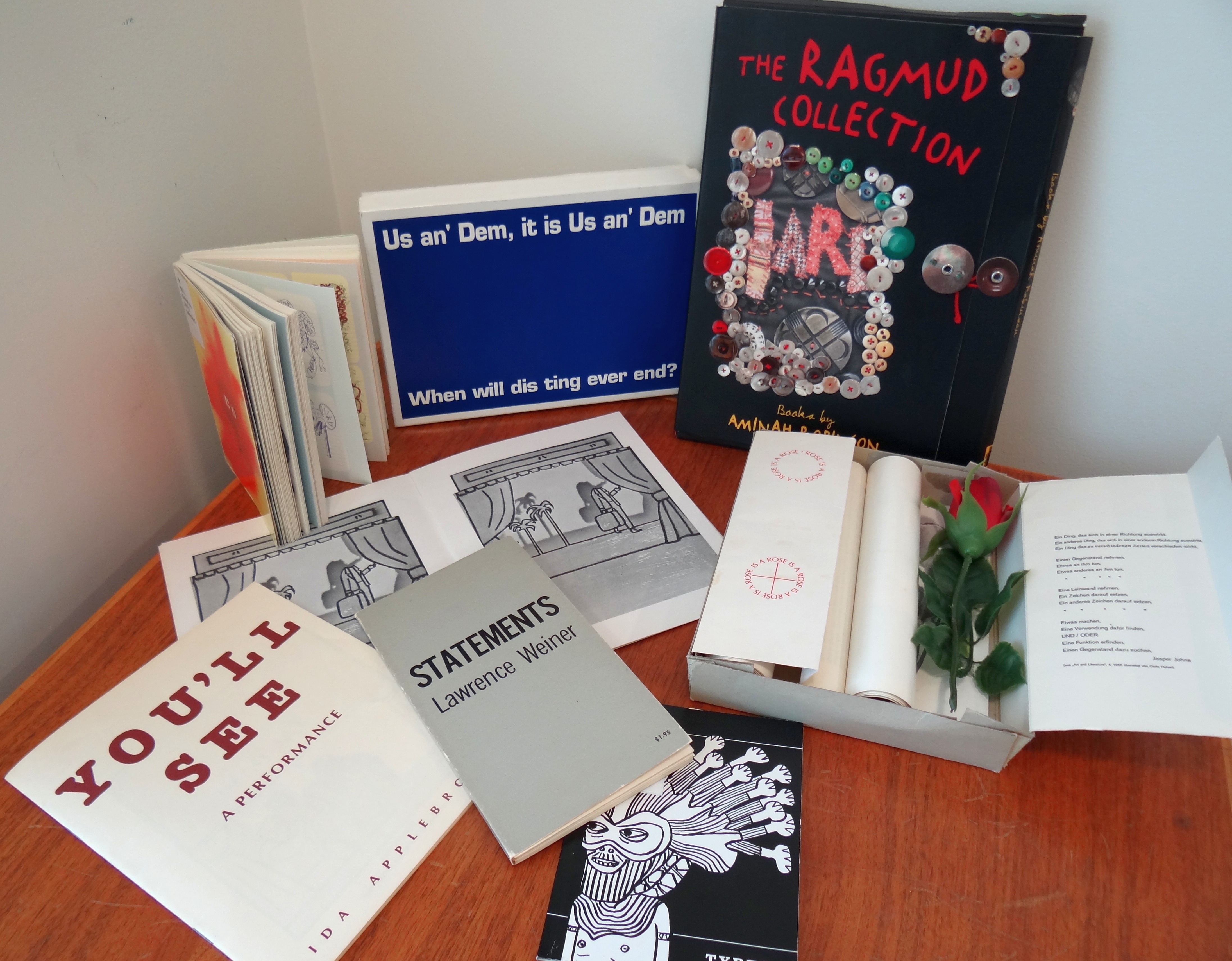
Although artists have illustrated the words of others in books since the advent of the printed book itself in the 1400s, the book as art object is a product of the 20th century. In Europe from the 1950s, artists were experimenting with the book format, making books with unique printing and bindings, such as slits or holes cut through the pages and unique shapes for the binding or boxing. In the United States, Ed Ruscha produced some of the first artists’ books consisting of compilations of photographs with a title on the front cover and little narrative quality. Other artists used the book format to create narratives to deal with difficult or emotional issues, and some used it as a cheap, portable way to make the artwork available to a broader public than the gallery and museum world allowed.
Fast forward to today, artists’ books exist at the intersections of printmaking, photography, poetry, experimental narrative, visual arts, graphic design, and publishing. Artists’ books have made a place for themselves in the collections of museums, libraries and bibliophiles, they have caught the interest of art historians and critics writing about art, and there are numerous studio programs in art schools dedicated to the art of the book, ushering in new generations of artists making books.
There are a few complications with artists’ books. Compared with other 20th century art movements and media, such as Conceptualism or sculpture, there are few scholarly texts dedicated to the medium, and the existing scholarship does not always agree! Even how to properly punctuate the term is disputed: whether “artist’s book,” “artists book” or “artist book.” Not to mention the question of where they physically belong—in museums or in libraries? Books are meant to be touched, and their pages turned, but an art object is usually only experienced under glass in a museum. These are issues that affect the work of artists, practitioners of book arts, curators, museum collections staff, librarians, publishers and others.
Yet the problems of the ambivalent nature of the artist’s book is part of what gives it such interesting potential.
And stay tuned for upcoming posts on artists’ books in the collection of the Smithsonian AA/PG Library!
For more general information on artists’ books, please see:
The Bonefolder: an e-journal for the bookbinder and book artist.
Printed Matter: non-profit organization dedicated to the promotion of publications made by artists.
Artists’ Books: a critical anthology and sourcebook. ed. Joan Lyons. Rochester: The Visual Studies Workshop Press, 1985.
Bury, Stephen. Artists’ Books: the Book as a Work of Art, 1963-1995. Aldershot: Scolar Press, 1995.
Castleman, Riva. A Century of Artists Books. New York: Museum of Modern Art, 1994.
Drucker, Johanna. The Century of Artists’ Books. 2nd ed. New York City: Granary Books, 2004.
Artist/Author: Contemporary Artists’ Books. Eds. Cornelia Lauf and Clive Phillpot. New York: Art Publishers Inc., 1998.
Perrée, Rob. Cover to cover: the artist’s book in perspective. Rotterdam : NAi Publishers, 2002.
More artists books that are still books

|
Book Art Object 2
Edited by Peter Koch and David Jury. Photography by Douglas Sandberg.
ISBN: 978-0-911221-50-3
Following the highly successful and acclaimed Book Art Object, published in 2008, Book Art Object 2 includes a record of the third biennial Codex Book Fair and Symposium: “The Fate of the Art,” held in Berkeley, California, 2011. Codex events showcase contemporary artist books, fine press and fine art editions produced by the world’s most esteemed printers, designers, book artists, and artisans.
This book contains 1133 images of 300 books by 140 artists/printers. Also presented is a selection of the papers delivered at the 2009 and 2011 symposia:
|
Book Art Object 2 explores the ingenuity of book makers from the point of view of the printers, the artists, the curators, the collectors, and others involved in the enchanting world of handmade books and graphic arts. This book celebrates a combined professionalism and imagination – and brings you as close to the surprising originals as you can without owning them. Nowhere else, one finds such quality. The book is a must for the inquisitive.
—Paul van Capelleveen, The National Library of the Netherlands.
Artists books that are still books.
“Books don’t respect boundaries, languages, or
limits, so the field must be interdisciplinary and international. In the
end Darnton says that books make history, they don’t merely recount it.”
davidjgary.com/.../summary-of-darntons-what-is-the-history-of-books/

Book Art Object
by David Jury
SBN-13: 978-0981791401 ISBN-10: 0981791409
Edition: 1st
Book Art Object may be the most ambitious and diverse survey of artist's books and the book arts published to date. Across its 400-plus pages of sumptuous color reproductions, it tracks the present state of the art throughout every continent (including Antarctica!) and through every variant of the book arts, from one-off publications to letterpress to artist/poet collaborations to artist's books. Stalwarts of the artist's book circuit such as Brad Freeman and Granary Books are represented here, as well as newer artist's book publishers such as Dobbin Mill, Otis Laboratory Press and Red Trillum Press. Also well represented are small literary presses such as Chax Press, Arion Press, Indulgence Press and Nikodim Publishing. A visual record of the proceedings and exhibitors attending the first biennial Codex International Book Fair and Symposium, Book Art Object collects work by many of the world's most esteemed printers, book artists and artisans into a single satisfying volume
Reincarnation


Books have always been valued for their physical "object-ness" They have always been far more than simply words on paper. Books have been elaborately illustrated, adorned with rare materials that serve as book covers, and have been monetarily valued as priceless. But once almost any book comes to the end of the road in terms of it's physical condition, it is fair game for artists who use the idea of a book as a metaphor or symbol.
Some popular techniques for transforming an existing book into an art book are origami, papier mache, gluing, cutting, and laminating. Artists also often use the existing pages as they are, print included as a raw material for the content of THEIR book. For instance, if the concept of the artist work is an investigation into the feminine role of "Princess", she might select an existing book on that theme for her artwork.
Books pages can be drawn on using graphite, colored pencil, marker, and crayon. They can be painted on with gouache, or India inks. If sealed with gesso they can even accept acrylic, and tempera paints.
Found materials can be glued, taped, stitched, stapled, or even riveted onto a page or pages. The possibilities are endless.
It is little wonder that deceased books are so often used by artists as an art medium.

Subscribe to:
Posts (Atom)